
How to Choose a Flooring Contractor in Atlanta

Few home improvement projects transform the everyday luxury, acoustic comfort, and appraisal value of an Atlanta residence as dramatically as new flooring. Whether investing $4,000 in a showroom polyaspartic garage floor or $18,000 in whole-home wide-plank white oak, the long-term success of the installation relies almost entirely on the craftsmanship, technical rigor, and accountability of the installation crew. Unfortunately, the flooring industry in Georgia harbors an uncomfortable regulatory secret.
In the State of Georgia, general flooring installation, concrete epoxy coatings, and hardwood refinishing are completely unregulated specialty trades. Unlike electrical, plumbing, HVAC, or residential general contracting, the Georgia Secretary of State Professional Licensing Board does not issue or require a dedicated trade license for flooring installers. Literally anyone with magnetic truck signs, rented tools, and printed business cards can legally advertise as a "flooring expert." In an open market saturated with third-party lead brokers and transient subcontractors, consumer due diligence is your only protection against catastrophic structural failures.
Get a Free On-Site Flooring Consultation
Speak directly with Pedro and the Diamond Epoxy Pros crew. We inspect your subfloor or concrete slab, test moisture levels, and provide a clear, itemized quote in writing.
- 5★ on Google (22 reviews)
- Fully Insured
- Free Written Estimates
- Lifetime Delamination Warranty
- Employees Only (No Subcontractors)
- Serving Metro Atlanta since 2023
The Georgia Licensing Void: Why Due Diligence is Critical in Metro Atlanta
The Distinction Between General Contractors and Specialty Flooring Crews
While the Georgia State Licensing Board for Residential and General Contractors licenses builders overseeing major structural remodels exceeding $2,500, specialty trade contractors performing standalone flooring, painting, and drywall installations are classified as exempt specialty trade contractors. While this reduces regulatory overhead, it opens the floodgates to inexperienced handymen who lack understanding of concrete moisture vapor emission rates (MVER), subfloor deflection mathematics, and polymer chemistry cross-linking.
The Subcontractor Broker Model vs. Dedicated In-House Craftsmen
Across metro Atlanta, a massive percentage of heavily advertised flooring companies are not actual flooring contractors; they are marketing brokers. A smooth sales representative visits your home, calculates square footage, collects a 50% deposit, and then auctions off the labor contract to the lowest-bidding independent crew on a morning dispatch board. The salesperson never sets foot on your property again, and the workers arriving at your home have no direct accountability to you or the broker.
At Diamond Epoxy Pros, we reject the broker model entirely. Founders Pedro and Marco personally lead our dedicated, tightly knit installation crew on every single residential and commercial job. When you hire us, the craftsmen executing the diamond grinding, leveling, and coating are full-time team members with years of synchronized field experience.
The 7 Mandatory Verification Checks Before Hiring Any Atlanta Flooring Contractor
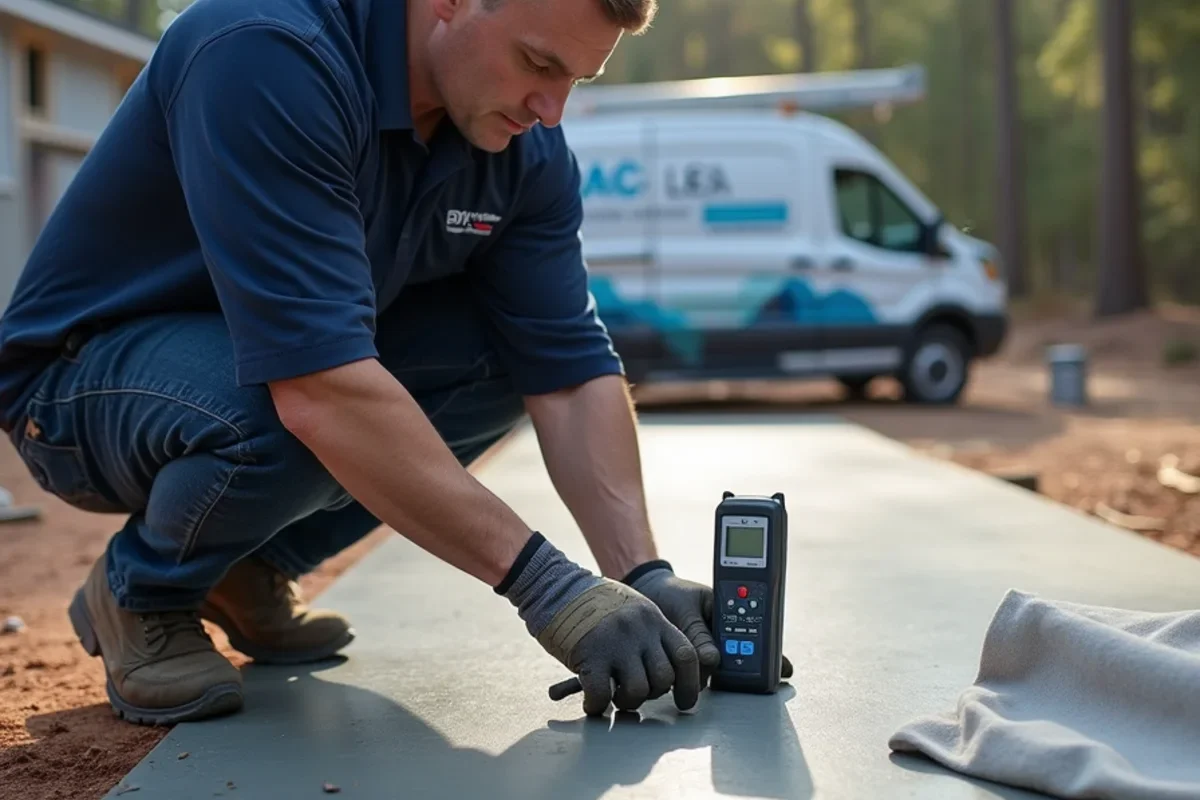
Before signing any contract or releasing financial deposits, insist on verifying these seven non-negotiable professional benchmarks.
Check 1: Demand a Certificate of Insurance (COI) Direct from the Agent
Never accept a photocopied or printed insurance certificate handed to you by a contractor; rogue operators frequently keep expired or canceled certificates in their trucks. Require that the contractor’s independent insurance agency email a Certificate of Insurance directly to you listing your name and property address as the "Certificate Holder." The COI must show at least $1,000,000 to $2,000,000 in Commercial General Liability coverage, plus active Statutory Workers’ Compensation covering every crew member on site.
Check 2: Require Quantitative Substrate Moisture Testing Protocols
Metro Atlanta sits on moisture-retentive Piedmont red clay, making ground-level slabs and crawlspaces chronic moisture risks. Any contractor who walks in and begins installing LVP, hardwood, or epoxy without measuring moisture is setting your floor up for bubbling, mold, and hollow delamination. Reputable installers carry calibrated digital pin meters (Delmhorst/Tramex) for wood subfloors and execute in-situ relative humidity probe tests (ASTM F2170) on concrete slabs.
Check 3: Verify Mechanical Surface Preparation Standards (ICRI CSP 2–3)
For garage and commercial epoxy installations, ask specifically: "What equipment do you use for surface prep?" If the contractor mentions pressure washing or muriatic acid etching, show them the door. Acid washing only cleans surface dirt and leaves concrete pores clogged with calcium salts, causing hot-tire peeling within months. True professionals deploy 600-lb planetary diamond grinders with pulse-jet HEPA extractors to achieve an ICRI Concrete Surface Profile of CSP-2 to CSP-3.
Check 4: Inspect Authentic Google Reviews with Specific Crew Mentions

Examine Google Business Profile reviews carefully. Disregard generic 5-star ratings with no text. Look for detailed narrative reviews where homeowners specifically mention the names of the installers (such as Pedro and Marco), praise jobsite cleanliness, highlight punctual arrival, and confirm that the floor still looks immaculate 12 to 24 months after installation.
Check 5: Insist on an Itemized Scope of Work and Fixed Turnkey Pricing
A professional contract separates each scope item into transparent line items: tear-out and disposal fees, subfloor leveling allowances, moisture barrier specifications, exact product brand names and model numbers, wear layer thickness (20-mil minimum), transition moldings, and baseboards. Avoid single-line lump-sum quotes that allow unscrupulous contractors to hit you with $2,000 in unexpected change orders on day one.
Check 6: Confirm Written Contractor Installation Warranties
Distinguish between manufacturer material warranties and contractor workmanship warranties. A manufacturer warranty only covers manufacturing flaws in the plank or resin; if the floor buckles from improper expansion gaps or peels from poor diamond grinding, the manufacturer will void the claim. Demand a written, company-backed workmanship warranty guaranteeing that installation defects and delamination will be repaired at zero labor cost to you.
Check 7: Review Acclimation and Environmental Controls Protocols
In Georgia’s volatile climate, flooring materials must acclimate inside your conditioned home for at least 48 to 72 hours prior to installation. Ask your contractor where the flooring will be stored prior to installation; if they plan to deliver planks directly from an unconditioned shipping container and install them the same hour, thermal shock will cause joint separation once your HVAC runs.
Questions to Ask Before Hiring an Atlanta Flooring Contractor
| Verification Category | Professional Standard (Diamond Epoxy Pros) | Industry Red Flag Warning Signs |
|---|---|---|
| Labor Accountability | Dedicated owner-led employee crew on site every day | Subcontracts to third-party daily labor; owner never visits |
| Insurance Documentation | Direct agent-issued COI ($2M general liability + WC) | Provides photocopied certificate or claims umbrella exemption |
| Subfloor Moisture Testing | Calibrated digital pin & ASTM F2170 in-situ probe testing | Visual check only; installs immediately upon arrival |
| Surface Preparation | Planetary diamond grinding with OSHA pulse-jet HEPA | Muriatic acid wash, pressure washing, or no prep |
| Warranty Scope | Written lifetime residential delamination warranty | Verbal promises; "call the manufacturer if it peels" |
| Payment Schedule | Sensible milestone schedule (1/3 deposit, balance at completion) | Demands 50% to 100% upfront in cash or wire transfer |
Technical Red Flags to Spot During In-Home Consultations
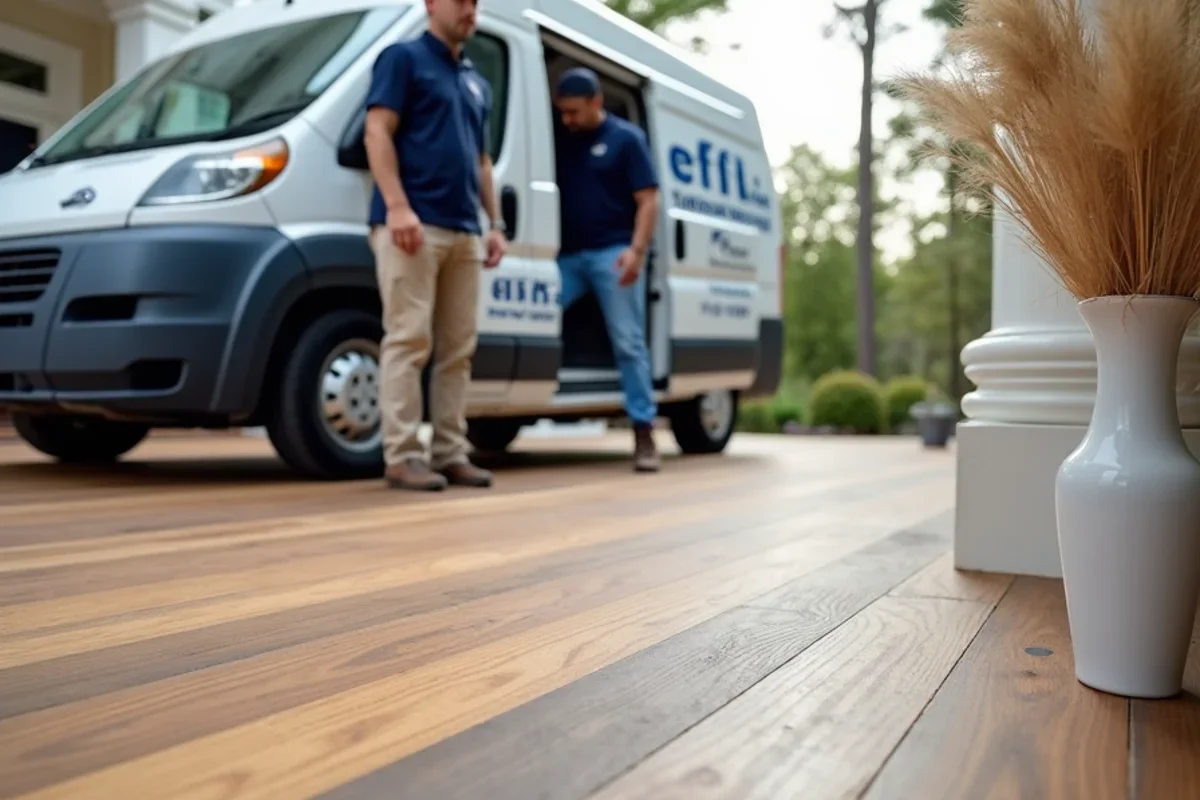
When flooring estimators visit your home, observant homeowners can spot amateur contractors within minutes.
The "Eyeball Level" and Skipping Straightedge Mapping
Professional installers never estimate subfloor flatness by sight. If an estimator does not pull a 6-foot or 10-foot straightedge or laser level across your high-traffic rooms, they cannot accurately quote subfloor preparation. Floating LVP requires flatness within 3/16-inch over 10 feet; quoting an installation without checking floor flatness guarantees surprise change orders once your old carpet is ripped up.
The "One-Day Polyaspartic" Myth in Unprepared Conditions
While polyaspartic coatings cure rapidly, Beware of franchises promising a complete garage floor installation in 4 to 6 hours total. Rushing through diamond grinding, skipping proper polyurea crack curing time, and applying basecoats over damp concrete leads to trapped vapor blisters. True industrial systems require methodical two-day sequencing: deep grinding, crack routing, basecoat and full flake saturation to rejection on Day 1, followed by scraping, HEPA vacuuming, and thick aliphatic clear coat on Day 2.
Payment Terms and Contract Best Practices in Georgia Construction Law
Milestone Payments vs. Large Upfront Cash Deposits
In Georgia, reputable trade contractors operate on reasonable milestone progress schedules. A typical professional structure involves: 30% to 33% upon contract signing to order custom materials, 33% upon delivery of materials and commencement of demolition, and the final 34% only after the final punch-list walkthrough is completed and approved by the homeowner. Never pay 50% or 100% upfront to an unknown contractor.
Lien Waivers: Protecting Your Property Title Against Material Liens
Under Georgia construction lien laws (O.C.G.A. § 44-14-361), material supply houses (such as lumber yards or wholesale tile distributors) can place a mechanics lien on your home if the contractor fails to pay for the materials used on your job—even if you paid the contractor in full! To protect yourself, always require an Interim Lien Waiver with progress payments and a Final Unconditional Lien Waiver before issuing final payment.
Why Founder-Led Accountable Operations Deliver Long-Term Peace of Mind
On-Site Founder Leadership: Pedro & Marco Direct Supervision
At Diamond Epoxy Pros, our founders Pedro and Marco are on the jobsite from initial diamond grinding through the final wipe-down. This hands-on presence ensures uncompromising attention to expansion gap tolerances, crisp transition lines, and thorough HEPA vacuuming. We treat your home with the same respect, cleanliness, and precision we would expect in our own residences.
Post-Installation Walkthrough and Environmental Disposal Accountability
Our work concludes with a comprehensive, step-by-step physical walkthrough. We inspect every transition molding, check door clearance undercuts, provide written manufacturer warranty packets, and haul away 100% of demolition debris, leaving your home spotless and ready for immediate living.
Frequently Asked Questions
- No. The Georgia Secretary of State Professional Licensing Board does not issue or require a specific trade license for flooring installers, hardwood refinishers, or concrete coating contractors. Because the trade is unregulated in Georgia, homeowners must rigorously verify active general liability insurance, workers’ compensation coverage, manufacturer certifications, and verified local Google reviews before hiring.