
Flooded Basement Floor After Heavy Rain: Next Steps
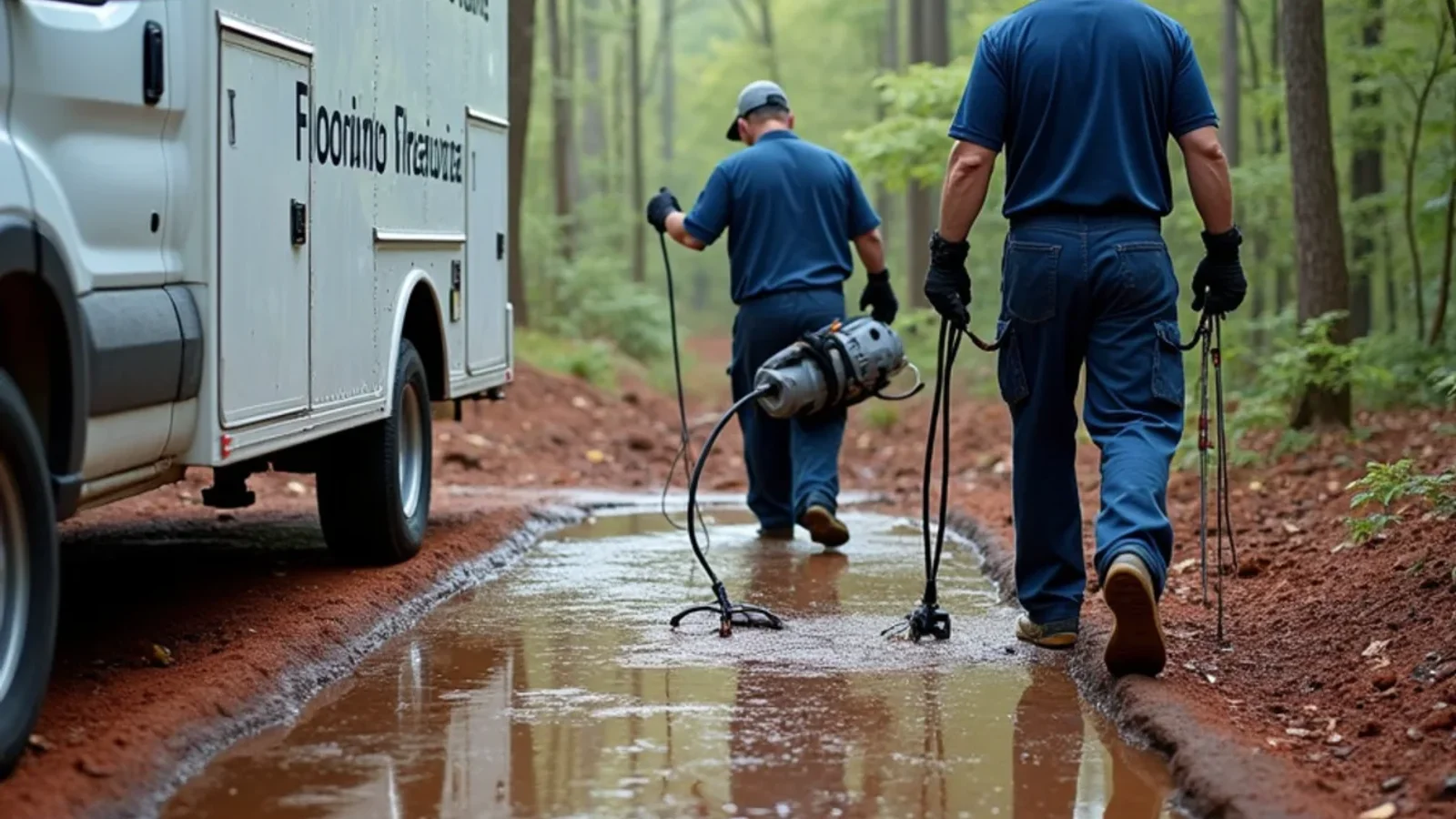
When severe thunderstorms or tropical remnants sweep through metro Atlanta, hillside daylight basements and terrace levels bear severe hydrostatic pressure. Saturated Piedmont clay soils swell against masonry foundations, forcing runoff and ground water through slab joints. If you face standing water in your Fulton, Cobb, or DeKalb County basement, immediate, systematically sequenced steps determine whether your home suffers microbial growth or transitions into a fully remediated, flood-resilient space.
Water entering from outdoors is never clean. Filtering through backfill soil carries silt, organic decay, fertilizer nitrates, and bacterial flora. This classification dictates demolition thresholds for porous floor coverings like carpet padding and laminate, as well as decontamination protocols required before new moisture-impermeable flooring systems can be installed.
Get a Free On-Site Flooring Consultation
Speak directly with Pedro and the Diamond Epoxy Pros crew. We inspect your subfloor or concrete slab, test moisture levels, and provide a clear, itemized quote in writing.
- 5★ on Google (22 reviews)
- Fully Insured
- Free Written Estimates
- Lifetime Delamination Warranty
- Employees Only (No Subcontractors)
- Serving Metro Atlanta since 2023
Immediate Emergency Triage: Water Categories, Safety, and Extraction
Electrical Isolation and Structural Safety Verifications
Before stepping into a flooded basement, life safety comes first. Submerged baseboard heaters, floor outlets, sump cords, and water heaters create electrocution risks if water reaches energized equipment. If your electrical panel is safely accessible away from standing water, trip individual breakers supplying basement circuits. If the main panel is in the flooded area, contact Georgia Power or an emergency electrician for an exterior meter disconnect.
Next, evaluate structural stability. In heavy downpours around Sandy Springs, Smyrna, and Vinings along the Chattahoochee basin, soil saturation exerts massive lateral hydrostatic forces against block foundation walls. Inspect perimeter walls for active stair-step cracks, inward bowing, or pressurized water spouts. If foundation walls exhibit noticeable inward displacement or active mud slides through windows, evacuate immediately and consult a structural engineer.
Water Intrusion Classification (IICRC S500 Standards)
Professional restoration follows the IICRC S500 Standard, categorizing flood water into three contamination tiers:
- Category 1 (Clean Water): From sanitary sources like ruptured copper supply lines. Rare in severe weather flooding.
- Category 2 (Gray Water): Contains chemical or biological contaminants causing illness on contact, such as sump basin overflows and foundation seepage carrying dissolved soil particulates.
- Category 3 (Black Water): Grossly unsanitary water laden with pathogens, sewage, or heavy silt, including storm runoff through window wells, overflowing creeks (Peachtree or Sweetwater Creek), and sewer backups.
Water categories degrade rapidly. Clean or gray water trapped beneath finished flooring for over 48 hours at warm Georgia temperatures (>75°F, >70% RH) transitions into Category 3 black water as bacteria proliferate within damp padding and adhesives.
High-Volume Water Extraction and Perimeter Containment
Every hour standing water remains atop concrete, capillary suction draws moisture deeper into slab pores. Deploy truck-mounted extraction units and submersible trash pumps immediately to purge bulk water. If water entered through daylight French doors or patio wells, erect sandbag diversion barriers and clear clogged yard catch basins to halt continuous replenishment.
Flooring Salvage Assessment: What Stays and What Goes
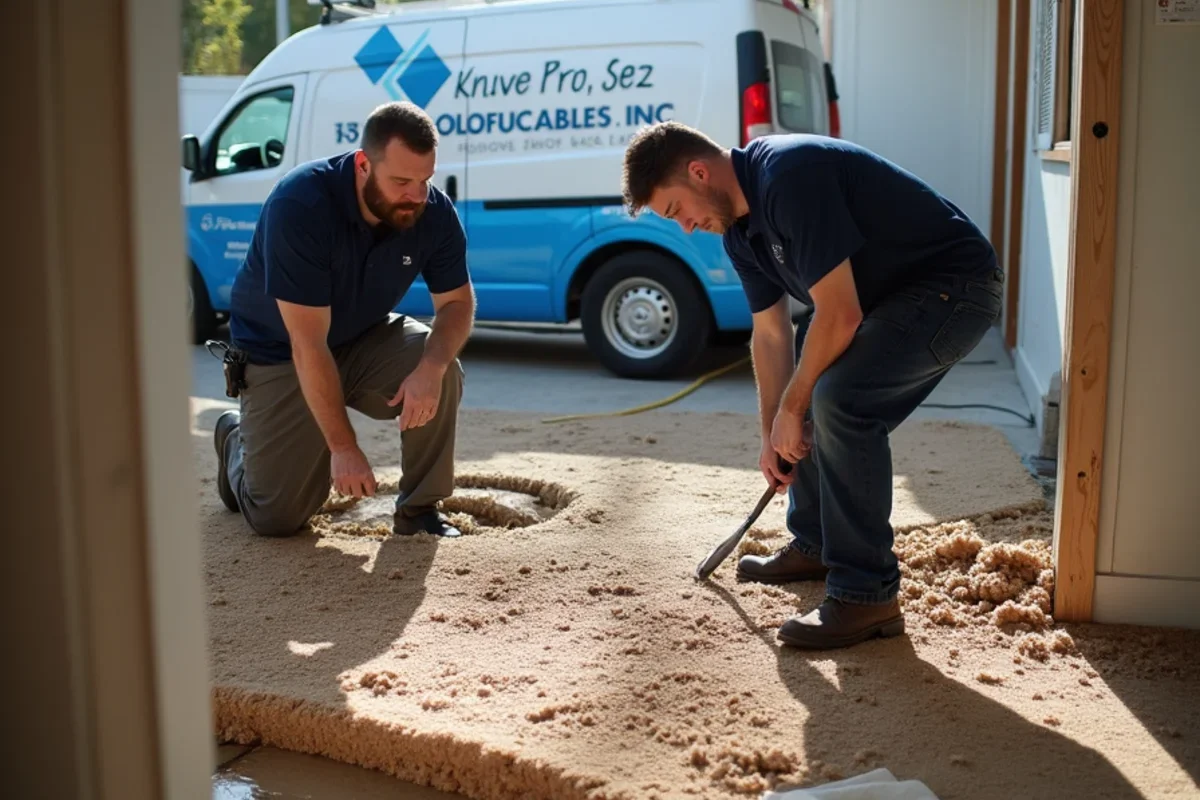
Once bulk water is removed, homeowners face critical decisions on floor coverings. Porous materials that harbor bio-contaminants must be dismantled to prevent chronic mold spore distribution throughout the HVAC system.
The Carpet and Underlayment Rule: Non-Negotiable Demolition
Wall-to-wall tufted carpeting over rebond padding in a flooded basement is almost never salvageable. Rebond padding acts as an open-cell sponge trapping silt and microbial contaminants against cold concrete. Extraction cannot evacuate trapped water from dense foam matrices. Perimeter tack strips rust carbon steel nails into the slab and rot. Slice carpet into 3-foot strips, roll with the pad inside, bag for disposal, and pry off all rusted tack strips.
Laminate, Engineered Hardwood, and Rigid SPC Vinyl Planks
Laminate flooring with high-density fiberboard (HDF) cores suffers irreversible structural breakdown when exposed to standing water. The compressed wood fibers swell at joints, blister, and peak permanently. Full tear-out is mandatory.
Engineered hardwood glued or floated over concrete faces severe ply delamination and adhesive breakdown under hydrostatic pressure. Unless exposed to Category 1 water for less than 4 hours under desiccant tenting, replacement is required.
Stone Polymer Composite (SPC) rigid core vinyl planks represent an exception. Made of limestone composite and PVC resins, the planks are waterproof and will not swell. However, water traps underneath against the slab, fostering mold on attached IXPE foam pads. Fortunately, SPC planks can be carefully unclicked, numbered, sanitized with antimicrobial wash, air dried vertically, and reinstalled over dry concrete.
Salvage vs. Replacement Matrix for Flooded Basement Floors
| Flooring System | Moisture Vulnerability | Salvage Feasibility | Standard Action Protocol | Typical Replacement Timeline |
|---|---|---|---|---|
| Tufted Carpet & Rebond Pad | High absorption of silt and microbes | 0% (Mandatory tear-out) | Roll in 3-ft strips, discard pad/tack strips, sanitize bare slab | Immediate disposal; slab dry in 7-14 days |
| HDF-Core Laminate Flooring | Fiberboard core swells and blisters permanently | 0% (Irreversible joint expansion) | Demolish floating planks, bag cores, discard soggy underlayment | Full disposal; slab dry in 5-10 days |
| Glued Engineered Hardwood | Ply delamination and adhesive failure | 5-10% (Only if Cat 1 < 4 hrs) | Scrape delaminated plies, grind mastic residue with diamond tools | Demolition required; slab dry in 10-18 days |
| Rigid Core SPC Luxury Vinyl | Planks unaffected; water traps underneath | 85-95% (If unclicked carefully) | Unclick rows, sanitize with quaternary wash, dry vertically | Cleaned & reinstalled in 5-7 days |
| Commercial Flake Epoxy | 100% monolithic seamless surface; impervious | 100% Salvageable | Squeegee standing water, sanitize with virucidal wash, dry with fans | Fully operational in 12-24 hours |
Structural Drying Protocol for Concrete Basement Slabs
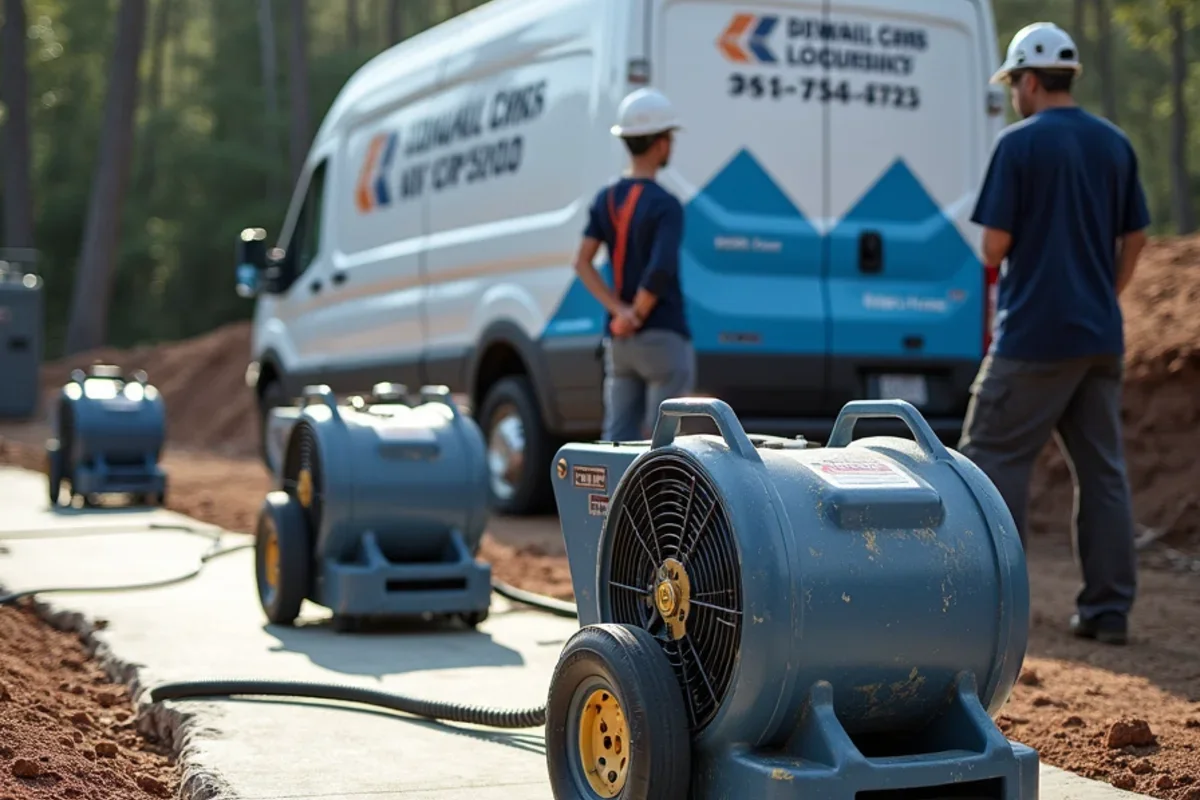
Removing ruined floor coverings reveals bare concrete, but concrete is a porous capillary matrix. A 4-inch-thick residential basement slab across 1,500 square feet can hold hundreds of gallons of water within its pore network without visible pooling.
Deployment of High-Velocity Air Movers and LGR Dehumidification
Opening windows during a Georgia summer drives more humidity into cool basements. Professional structural drying requires closed-envelope psychrometric management:
- 1
High-Velocity Centrifugal Air Movers
Position units every 10 to 14 feet along foundation walls angled at 45 degrees to sweep away the saturated boundary layer and accelerate evaporation.
- 2
Low-Grain Refrigerant (LGR) Dehumidifiers
Commercial LGR units pull humidity below 30 grains per pound (GPP), establishing the aggressive vapor differential needed to draw deep slab moisture.
- 3
HEPA Air Scrubbers
For Category 2 or 3 water, run 500 CFM HEPA scrubbers to filter airborne mold spores, mycotoxins, and demolition dust.
- 4
Antimicrobial Slab Decontamination
Saturate raw concrete with EPA-registered botanical disinfectant (like Benefect Decon 30) to eliminate bacteria in microscopic pores.
Quantitative Moisture Testing: ASTM Standards
Never rely on touch or visual checks to confirm a slab is dry. Concrete can look dry while harboring 95% internal relative humidity. Certified quantitative testing includes:
- ASTM F2170 (In-Situ RH Probes): Drill holes to 40% slab depth (1.6 inches on 4-inch slabs), seal sleeves for 24 hours, and read internal relative humidity. Resilient floors require RH < 75-80%; specialized epoxy primers tolerate up to 99% RH.
- ASTM F1869 (Calcium Chloride MVER): Sealed domes measuring vapor emission over 60-72 hours. Standard floor coverings require emissions below 3.0 lbs/1,000 sq ft/24 hrs.
- Psychrometric Moisture Logging: Daily tracking of temperature, relative humidity, dew point, and GPP to confirm drying equilibrium.
Long-Term Flood Resilience: Permanent Basement Flooring Replacements
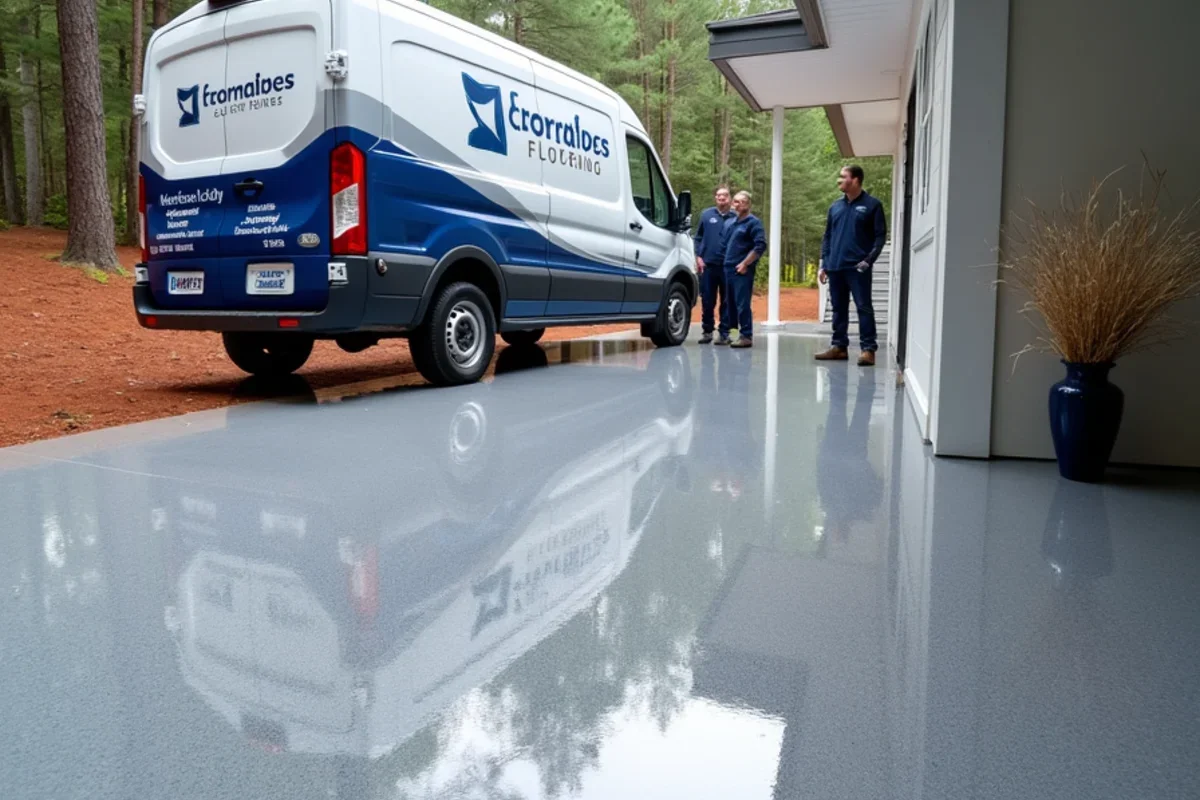
After enduring basement flooding, re-installing water-vulnerable carpet or laminate invites repeat disaster. Atlanta homeowners increasingly upgrade to monolithic, flood-impervious flooring systems engineered for hydrostatic durability.
100% Solids Moisture Vapor Barrier Epoxy Systems
The premier solution for finished basements is multi-layer commercial epoxy with an integrated moisture vapor mitigation primer. Unlike hardware-store DIY kits, professional 100% solids low-viscosity epoxy penetrates concrete pores and chemically cross-links within the capillary matrix.
These primers withstand hydrostatic pressures exceeding 15 to 25 lbs MVER and tolerate up to 99% in-situ slab RH (ASTM F2170). Saturated with decorative vinyl flakes or colored quartz aggregate and sealed with aliphatic polyaspartic clear coats, the floor delivers a seamless finish completely impervious to standing water, bleach cleaning, and mold.
Mechanically Polished Concrete vs. Glazed Porcelain Tile
For modern aesthetics, diamond-polished concrete offers natural breathability. Successive diamond grits and lithium silicate densification consolidate the slab into a reflective stone surface without topical films, allowing moisture vapor to breathe naturally without blistering.
Glazed porcelain tile over an uncoupling waterproof membrane (like Schluter-DITRA) also provides high water endurance. Porcelain absorbs under 0.5% water by weight. Joints must be sealed with high-performance epoxy grout rather than cementitious grout to prevent dirty flood silt from staining lines.
Insurance Claims, Documentation, and Contractor Coordination
Sump Pump Failure vs. Surface Ground Flooding
Standard Georgia HO-3 homeowners insurance policies exclude groundwater and surface flooding unless a separate flood policy is held. However, most policies include a "Water Backup of Sewer/Drain and Sump Pump Overflow" rider ($10,000 to $50,000+). If power loss or mechanical failure stopped your sump pump, the resulting damage is typically covered.
Essential Documentation for Full Reimbursement
To support your claim before demolition crews haul materials away:
- Photographic and Video Evidence: Capture waterlines on drywall, saturated baseboards, and water entry points.
- Retain Failed Sump Pumps: Keep burned-out pump motors or switches for adjuster mechanical inspection.
- Moisture Logs: Request thermal imaging scans and psychrometric moisture logs from your restoration contractor.
- Detailed Flooring Estimate: Secure quotes specifying mechanical diamond grinding, moisture vapor mitigation primers, and waterproof seamless finishes.
Frequently Asked Questions
- No. Rebond and polyurethane carpet padding function as open-cell sponges that trap biological contaminants, silt, and dissolved minerals from flood water against the cold concrete slab. Even with truck-mounted hot water extraction, the interior foam structure cannot be completely sanitized or dried quickly enough to prevent virulent mold growth (Aspergillus and Penicillium) within 48 to 72 hours. All padding must be cut out and discarded. While synthetic carpets exposed to clean Category 1 water can occasionally be professionally restored off-site, groundwater or sump overflow intrusion (Category 2 or 3) requires complete disposal.